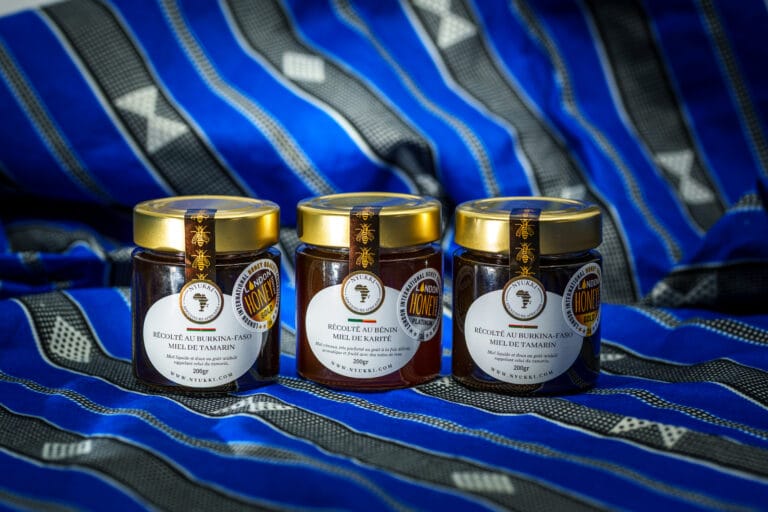

You open your jar of honey and, surprise: the runny honey from a few weeks ago has become thick, grainy, almost white. Should you throw it away? Is it still good? Has sugar been added? Rest assured: honey that crystallises is perfectly normal honey. In fact, it is often the sign of a honey that has been left raw. Here is what happens in the jar, and how to make the most of it.
Crystallisation, a natural process
Honey is made up of around 80% natural sugars, mainly two of them: glucose and fructose. It also contains a little water, usually less than 20%. So there is far more sugar than the water can keep dissolved: honey is what is called a “supersaturated” solution.
Over time, glucose, which dissolves less easily than fructose, separates out and forms small crystals. These crystals then cling to each other, and the honey gradually turns from liquid to solid. This is exactly what happens to most honeys in the world, sooner or later.
Why some honeys crystallise faster than others
However, not all honeys crystallise at the same pace. Some harden in a few days, while others stay liquid for months. Three things make the difference.
1. The flower the bees forage on
This is the main factor. Each flower produces nectar with its own proportion of glucose and fructose. As a result, the richer a honey is in glucose, the faster it crystallises. In Europe, for example, rapeseed honey sets in a few days, while acacia honey can stay liquid for more than a year.
We find the same diversity in our African honeys. Our mangrove honey from Madagascar crystallises quickly into beautiful white crystals. By contrast, tamarind honey and lychee honey stay very liquid. Our cashew apple honeycrystallises finely over time.
2. Temperature
Honey crystallises fastest at around 14 °C. That is why a jar kept in a cool cupboard in winter, or in the fridge, hardens faster. Above 25 °C, on the other hand, crystallisation slows down considerably.
3. What the honey contains
Raw honey naturally contains tiny grains of pollen and wax, which then act as starting points for the first crystals. A highly filtered, heated honey contains far fewer: it stays liquid longer, but it has lost part of what gave it its character.
Is crystallised honey a good sign?
Crystallisation alone does not prove that a honey is pure, and liquid honey is not necessarily adulterated. But it is the normal behaviour of a honey that has not been processed.
To keep honey liquid for a very long time, industry often heats it to high temperatures: this is pasteurisation. This step destroys the seeds of crystals, but it also changes the honey’s aromas. NYUKKI honeys are neither heated nor pasteurised : so it is completely normal for them to change in the jar, each at its own pace.
Crystallised does not mean out of date
Crystallised honey is neither spoiled nor out of date. It has the same taste and the same qualities as before. Only its texture has changed.
What you should not confuse with crystallisation is fermentation. It happens rarely, when a honey contains too much water or has been badly closed in a damp place. You can recognise it in particular by foam on the surface, small bubbles and a sour, slightly alcoholic smell. A simple lighter layer on top, on the other hand, is just slightly uneven crystallisation.
How to make crystallised honey liquid again
If you prefer your honey runny, simply warm it gently:
- Remove the lid and place the glass jar in a pan of warm water: this is a water bath.
- Heat very gently, without exceeding 40 °C : the water should feel warm to the touch, never boiling.
- Stir from time to time with a clean, dry spoon until the crystals disappear.
Avoid the microwave and boiling water, because too much heat damages the honey’s delicate aromas. Finally, bear in mind that your honey will eventually crystallise again, which is perfectly normal.
What if you actually like it crystallised?
In fact, many honey lovers prefer set honey. It does not drip, it spreads easily on bread without running off, and it melts slowly on the tongue. This is also the principle behind creamed honeys : a very fine crystallisation that gives them a smooth texture. Our shea honey and our eucalyptus honey are naturally creamy.
Crystallised honey is also very practical in the kitchen: it is easy to measure with a spoon and melts as soon as it touches a hot drink or a pan.
Storing your honey properly
- At room temperature, ideally around 18 to 20 °C. The fridge is unnecessary and speeds up crystallisation.
- Lid tightly closed : honey absorbs moisture from the air.
- Away from light and heat : avoid the windowsill or the top of the oven.
- Always with a clean, dry spoon, so you do not add water to the jar.
Stored this way, honey keeps its qualities for at least two years.
Frequently asked questions
My honey has crystallised: is it still good?
Yes. Crystallisation changes neither the taste nor the quality of the honey. Only the texture is different. So you can eat it as it is or make it runny again in a water bath.
Is honey that crystallises pure honey?
Crystallisation is the normal behaviour of unprocessed honey, but it is not enough to prove its purity. Some pure honeys, such as acacia or tamarind, naturally stay liquid for a very long time.
At what temperature should I melt crystallised honey?
In a water bath, without exceeding 40 °C. Above that, heat damages the honey’s aromas.
Why does my honey have a white layer on top?
Most of the time it is slightly uneven crystallisation, completely harmless. If you see foam and bubbles and notice a sour smell, it is more likely fermentation: the honey has absorbed moisture.
Should honey be kept in the fridge?
No, because cold speeds up crystallisation. Keep your honey at room temperature, tightly closed, away from light.
Want to compare textures? Discover our single-flower honeys from Africa, from the most liquid to the creamiest, harvested in Benin, Burkina Faso and Madagascar.